The GOLD Communication Framework
Understanding what people protect in conversation

So tension stops feeling personal.
Most communication advice focuses on what to say.
But tension in conversation usually begins before the words.
When something matters, people instinctively try to stabilize different things.
One person may try to protect connection.
Another may try to create structure.
Another may push toward understanding.
Another may push toward momentum.
When these priorities collide, conversations can quickly feel personal — even when both people mean well.
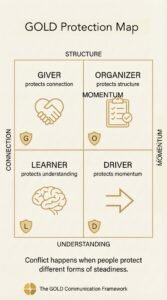
The GOLD Communication Framework explains what people are trying to protect when communication becomes important.
Creating a successful dialogue is much like navigating a complex landscape. Think of a time when you had a disagreement with a friend. Perhaps you both wanted to express your feelings, but neither of you understood what the other truly needed, leading to frustration. This highlights the importance of recognizing the underlying motivations in conversations.
For example, in a workplace meeting, one team member may be focused on achieving deadlines while another is concerned about team morale. These priorities can create tension if not addressed. By applying the GOLD Communication Framework, both parties can articulate their needs, leading to a more productive discussion.
Take the GOLD Communication quiz to further explore your communication style.
The GOLD Communication quiz can provide invaluable insights into your communication tendencies. For instance, you might discover that you often prioritize clarity over connection, which could lead to misunderstandings in personal relationships. By becoming aware of these patterns, you can make conscious efforts to adapt your communication style for better outcomes.
Take the GOLD Communication quiz to further explore your communication style.
Engaging with the quiz not only allows for personal growth but also fosters better interactions with others. Consider how understanding your communication style could enhance your collaboration in a team project. You may find that your strengths complement a colleague’s weaknesses, creating a more balanced approach to problem-solving.
The Four Conversation Stabilizers
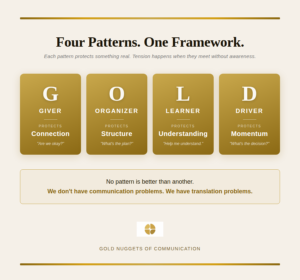
When conversations matter, people tend to protect one of four starting points.
Connection — The Giver
“I want to know we’re okay.”
People who stabilize connection instinctively focus on emotional safety. They want to make sure the relationship is steady before moving forward in the conversation.
Understanding — The Learner
“Help me understand.”
Learners stabilize clarity. They slow conversations down to make sure information is accurate, assumptions are clear, and everyone understands what is happening.
Structure — The Organizer
“Can we organize this?”
Organizers stabilize order. They want to define the plan, outline steps, and create structure so the conversation becomes manageable.
Momentum — The Driver
“So what’s the decision?”
Drivers stabilize progress. They push conversations toward movement, decisions, and action so the discussion doesn’t stall.
Healthy Conversations Follow a Sequence

In stable conversations, communication often moves through a natural order.
Connection → Understanding → Structure → Momentum
When this sequence unfolds naturally, conversations tend to feel calm and productive.
But tension appears when people try to stabilize different steps at the same time.
For example:
Driver:
“So what’s the decision?”
Giver:
“Can we slow down for a moment?”
Neither person is wrong.
They are protecting different things in the conversation.
The GOLD framework helps people recognize these patterns earlier so conversations can move forward more smoothly.
The GOLD Nuggets of Communication Course does a deep dive into "Understanding What Moves Beneath the Words"
Image Accordion #1
Image Accordion #1
Image Accordion #2
Image Accordion #3
Image Accordion #4
Why Conversations Break Down

Most communication conflict isn’t caused by bad intentions.
It often happens because people start conversations from different stabilizing points.
One person may try to restore connection while another tries to reach a decision.
One may want clarity while another wants to organize the plan.
Without recognizing these differences, both people can feel misunderstood.
When you understand what people are protecting, tension becomes easier to interpret — and easier to guide.
Imagine a scenario where two colleagues have different approaches to a project. One may focus on immediate results, while the other emphasizes thorough research. Tension can arise if neither party acknowledges the other’s perspective. Recognizing these underlying motivations can help both individuals navigate their differences more effectively, ultimately leading to a more cohesive team dynamic.
How the Framework Helps

The GOLD framework helps people:
- recognize what stabilizes them in conversation
- understand what others are protecting
- recognize tension earlier
- guide conversations through the natural sequence
Instead of reacting to tension, people begin to understand what is happening beneath the surface of communication. The Course explains this in depth.
By leveraging the GOLD framework, individuals can cultivate essential skills necessary for effective communication. For example, active listening is a crucial element. When we truly listen, we not only hear the words but also the emotions and intentions behind them. This deeper understanding can transform potential conflicts into collaborative discussions.
Discover Your Starting Point
Most people instinctively stabilize one of the four starting points first when communication becomes important.
The best way to understand the framework is to discover where you naturally begin.
Take the short awareness quiz to discover your starting point in the GOLD Communication Framework.
The GOLD framework describes communication patterns and is not a psychological assessment or clinical tool.
- Houston, TX
- goldnuggetsofcommunication@outlook.com
Copyright © 2026 Gold Nuggets of Communication, All rights reserved.